
Two ERC grants awarded to BioSysteM PIs
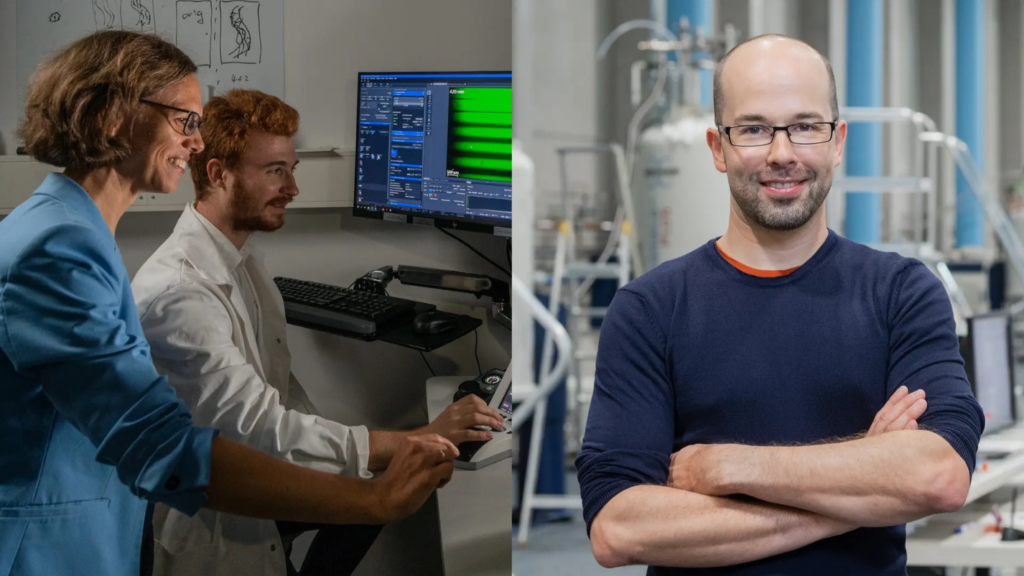
Prof. Dr. Karen Alim (left) and Prof. Dr. Matthias Feige (right). © Andreas Heddergott / TUM.
BioSysteM PIs Prof. Dr. Karen Alim and Prof. Dr. Matthias Feige received ERC Proof of Concept grants by the European Research Council (ERC). Through these grants, the ERC supports innovations based on research findings. They are awarded to researchers who want to investigate whether their ERC research projects can lead to commercially viable innovations.
Translating research into real-world applications is a central aim of BioSysteM.
Prof. Dr. Karen Alim
Cardiovascular diseases are among the leading causes of death worldwide. Many dangerous events such as stroke or heart attack start with tiny blood clots in small vessels – long before any symptoms appear. Current blood tests can hardly detect these early, localized changes. This is where Karen Alim’s FlowAgents project comes in: her team is developing a new sensing technology for vascular organ‑on‑chip systems that realistically model human blood vessels and thrombosis processes. Microscopic, biocompatible particles made of soft hydrogels, roughly the size and flexibility of blood cells, are used as sensors. Circulating with the blood flow through the organ‑on‑chip systems, these particles detect relevant biomarkers and store such events as a molecular “memory”. They then generate a fluorescence signal that reflects activity across the entire vascular network. In doing so, FlowAgents addresses a growing need in biomedical research for novel tools to better understand thrombosis processes. Together with academic partners and industry, the team aims to further develop the technology to bring it to market. In the long term, this approach could open up new possibilities for personalized diagnostics and early detection of cardiovascular disease.
Prof. Dr. Matthias Feige
Cancer therapies using genetically engineered immune cells are seen as a major hope, but so far they have struggled to tackle solid tumors. One key reason is that the tumor microenvironment strongly slows down immune cells. A particularly powerful immune booster is the signaling molecule interleukin‑12 (IL‑12). It can activate immune cells so that they attack tumors more effectively – but at doses high enough to be effective, IL‑12 is highly toxic for the whole body. This is where Matthias Feige’s OnsiteOkine project comes in: his team has developed a variant of IL‑12 that effectively includes an internal timer. It remains stable only in the immediate vicinity of its release site in engineered immune cells and then gradually falls apart into inactive components. In this way, IL‑12 is intended to exert its full effect directly in the tumor, while the rest of the body is spared. As a next step, the team plans to test the technology in animal models and, together with clinical and industry partners, advance it toward applications in patients.
We warmly congratulate Karen Alim and Matthias Feige on this achievement.
Further information and links:
Prof. Dr. Karen Alim
Prof. Dr. Matthias Feige
Full article: Five ERC grants awarded to TUM researchers